The problem
Institutional buyers need a documented, HSE-disciplined source for bulk petroleum trading.
Our approach
Bulk Petroleum Trading
Bulk Petroleum Trading delivered to institutional standard — structured procurement, chain-of-custody discipline, documented handover.
The Challenge
Bulk petroleum trading at institutional scale demands more than commercial access to product — it demands a documented chain of custody, structured procurement governance, and the kind of HSE discipline that withstands regulatory scrutiny. Across Ghana and Togo, the institutions carrying the heaviest operational exposure — mining conglomerates, aviation ground handlers, large-scale manufacturers, and government fleet operators — routinely encounter supply arrangements built around volume alone, with traceability and process accountability treated as secondary considerations. The consequence is exposure: product disputes without supporting documentation, delivery deviations that surface only at the point of consumption, and audit trails that fail under institutional review.
The trading environment across these two markets is further complicated by infrastructure variability, customs and cross-border regulatory requirements, and the operational pressure on procurement teams to maintain supply continuity regardless of market conditions. For any institution whose core operations depend on uninterrupted fuel supply — a mine running plant, a generator-dependent data centre, an airline maintaining turnaround schedules — a single undisciplined supply event carries consequences far beyond the transaction itself.
What the market rarely provides, and what every serious institutional buyer eventually discovers they require, is a petroleum trading partner whose process discipline matches their own governance expectations — one where every handover is documented, every specification is signed off in advance, and every deviation triggers a documented escalation rather than a verbal conversation.
The Kronix Energy Solution
Kronix Energy approaches bulk petroleum trading as a structured supply function, not a commodity transaction. The process begins before any product moves — with a pre-execution procurement specification document agreed between Kronix and the client’s procurement or operations team. This document governs product grade, delivery schedule, quantity tolerance, documentation requirements, and the handover acceptance protocol. Nothing proceeds without sign-off.
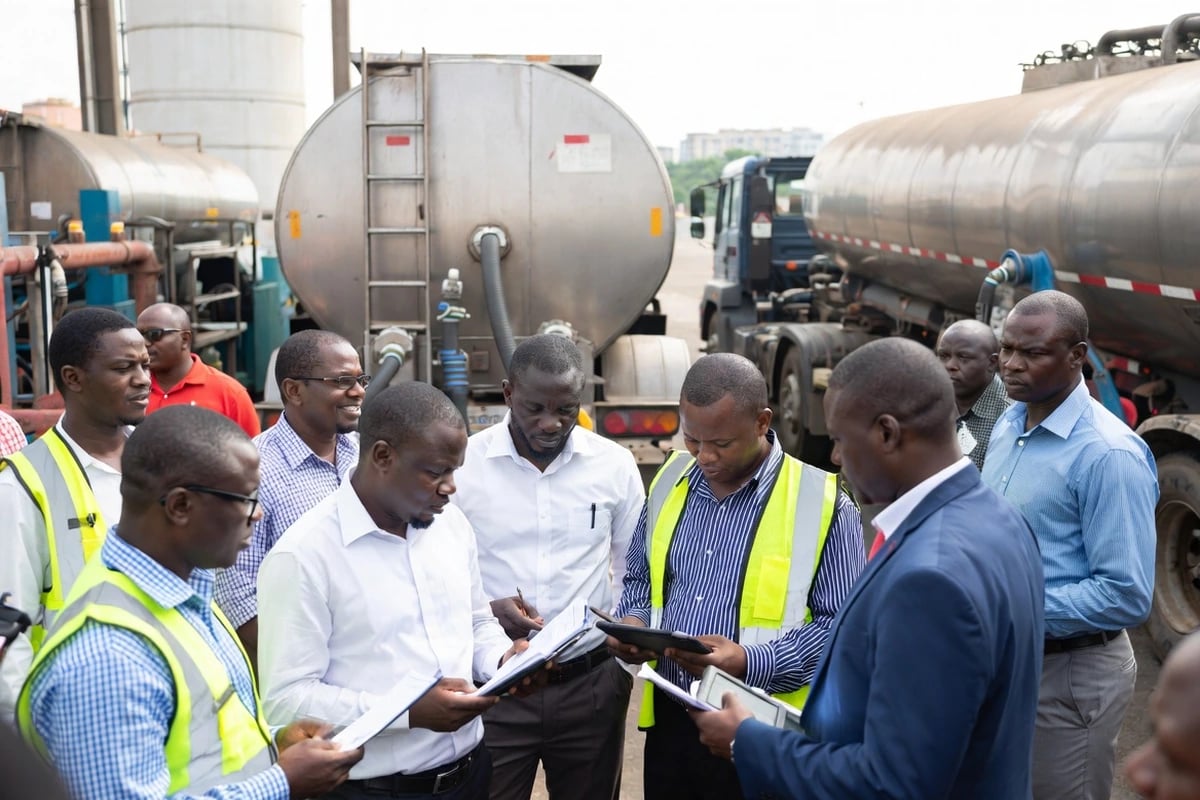
During the supply cycle, Kronix operates a multi-stage quality control and chain-of-custody process. Each transfer point — from source through transport through delivery — is documented and subject to checkpoint review. Deviations from specification are flagged and addressed at the stage where they occur, not retrospectively. This discipline is particularly consequential for clients operating across the Ghana–Togo corridor, where cross-border movement introduces additional compliance touchpoints that an underprepared trading partner routinely mismanages.
Post-delivery, Kronix provides documented handover records structured to support the client’s internal audit and procurement reporting obligations. The aftercare schedule ensures that any post-delivery product queries are handled within a defined process rather than left to informal resolution — a material distinction for clients operating under regulatory, lender, or board-level oversight.
Supply + Process Specification
- Product procurement governed by pre-agreed specification documents, signed off before supply mobilisation
- Multi-stage chain-of-custody documentation across all transfer and handover points
- Cross-border compliance management for Ghana–Togo corridor movements
- HSE-disciplined transport and delivery protocols aligned with ISO 9001, ISO 14001, and ISO 45001 frameworks
- Post-delivery documentation package structured for client audit, procurement reporting, and regulatory review
- Escalation protocol activated at any deviation from agreed specification — documented, tracked, resolved
Typical Supply Profile
A standard Kronix bulk petroleum trading engagement serves institutional buyers with recurring, high-volume fuel requirements — mining operations maintaining continuous plant activity, aviation handlers supporting scheduled ground services, manufacturers running energy-intensive production facilities, and government operations managing large mixed fleets. Engagements are structured around supply cycles appropriate to the client’s operational rhythm, with documentation and governance calibrated to the client’s procurement and compliance framework. Both single-market supply within Ghana and cross-border arrangements spanning Ghana and Togo are within standard operational scope.
Outcomes
- Procurement teams gain documented, auditable supply records that withstand internal and external review
- Operations management maintains supply continuity with deviation-management processes built in, not bolted on
- Compliance and finance functions receive handover documentation structured to their reporting requirements
- Cross-border supply across the Ghana–Togo corridor is managed within a single, governed engagement — eliminating the compliance gaps that multi-vendor arrangements routinely introduce
- Senior leadership operates with the confidence that petroleum supply is managed with the same process discipline applied to every other critical institutional function