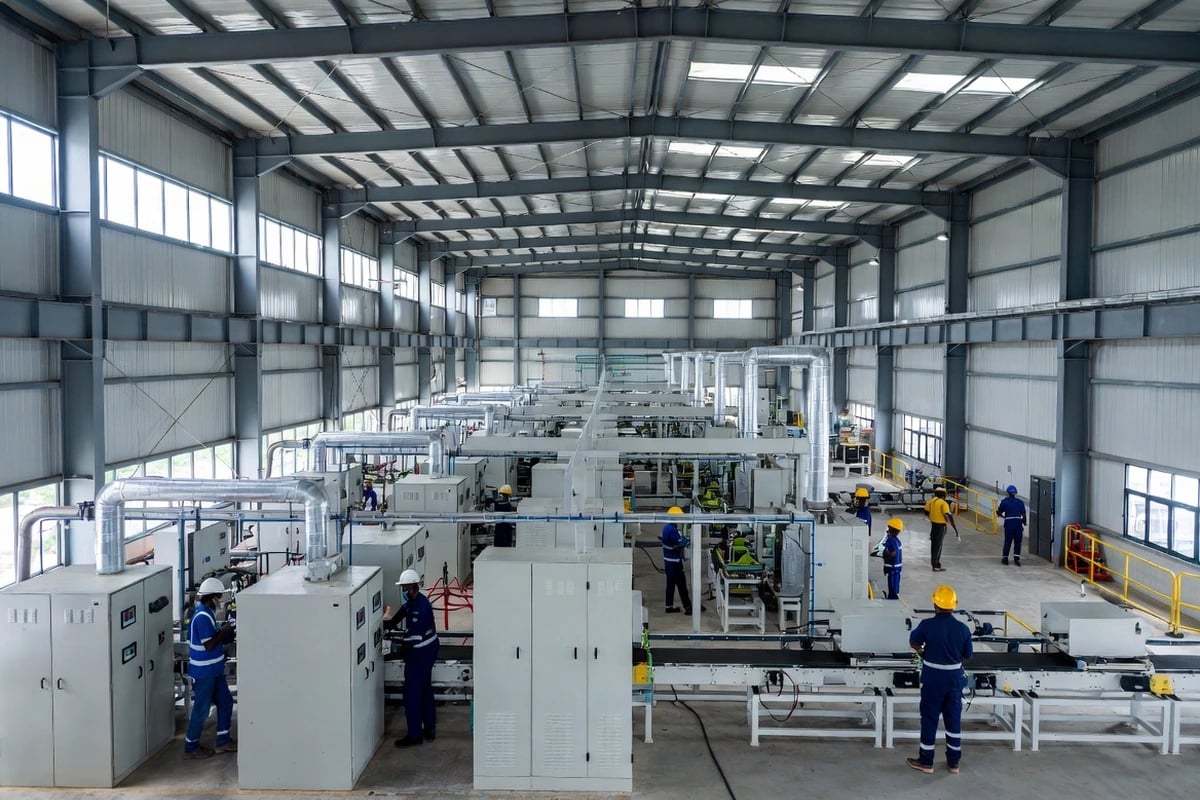
Why Manufacturing Specify Kronix Energy
Manufacturing operations run on continuity. A stalled production line does not recover its lost throughput — the cost accumulates in idle labour, delayed orders and contractual exposure that no single fuel delivery can undo. For plant managers and procurement leads responsible for keeping Ghanaian and Togolese manufacturing facilities running at specification, the discipline behind the supply chain matters as much as the product itself.
Kronix Energy was built for this operational reality. Every engagement begins with a documented supply assessment — volume requirements, storage capacity, delivery access constraints and product grade confirmation — before a single consignment moves. That pre-engagement rigour means manufacturing clients receive supply aligned precisely to their operational demands, not to a generic distribution schedule. The supply discipline institutions build on is not a slogan; it is the documented process governing each handover at the plant gate.
Specification Requirements Unique to Manufacturing
Industrial facilities introduce supply constraints that standard distribution channels are not configured to handle. Product grade integrity is non-negotiable: off-specification diesel reaching a generator bank or process-critical equipment introduces mechanical risk that carries consequences well beyond the cost of the fuel itself. Similarly, LPG supply to production processes and lubricant grades specified for heavy plant and conveyor systems demand chain-of-custody documentation from loading point to discharge — not assumed, but verified at each stage.
Regulatory compliance adds a further layer. Manufacturing sites operating under environmental permits, industrial zoning conditions and occupational health frameworks require fuel suppliers whose HSE protocols are auditable. Kronix Energy’s HSE-disciplined operating model is designed to produce the documentation that plant environmental officers, insurers and regulatory inspectors require — log-ready, consistent and traceable.
Recommended Services for Manufacturing
- Bulk Diesel Supply — scheduled and on-demand delivery to support generator banks, heavy plant and auxiliary power systems
- Industrial Lubricant Supply — specification-matched lubricants for manufacturing equipment, conveyor systems and compressed-air infrastructure
- LPG Supply — reliable LPG provisioning for production processes, heating applications and canteen operations
- Documented Delivery Management — chain-of-custody records, delivery confirmation documentation and reconciliation support for procurement and compliance teams
- Supply Continuity Planning — structured supply scheduling to align fuel availability with production calendars and planned maintenance windows
Notable Project Types
Manufacturing facilities across Ghana’s industrial corridors and Togo’s growing processing zones present a consistent pattern: high base-load diesel demand to sustain continuous operations, coupled with periodic surge requirements around planned maintenance periods when standby generation must carry the full facility load. Kronix Energy manages both steady-state scheduling and surge provisioning through the same documented framework, ensuring that neither scenario creates a compliance gap or a documentation break in the supply record.
Facilities processing perishable goods or operating temperature-sensitive production lines face a distinct supply criticality — power interruption is not a minor inconvenience but a production and regulatory event. For clients in this category, supply continuity planning and documented contingency protocols form a standing element of the engagement, structured before operations begin rather than assembled reactively when supply pressure arises.
Compliance and Standards
- HSE-Disciplined Operations — all supply and distribution activity governed by documented health, safety and environmental protocols aligned with ISO 45001 occupational health and safety principles
- Quality Management Framework — supply processes structured in alignment with ISO 9001 quality management principles, with multi-stage sign-off at loading, transit and delivery
- Environmental Stewardship — operational conduct aligned with ISO 14001 environmental management principles, supporting manufacturing clients’ own environmental permit obligations
- Chain-of-Custody Documentation — product provenance and grade integrity documented from supply point to plant delivery, available to procurement, compliance and audit teams on request
- Pre-Engagement Supply Assessment — documented volume, grade and logistics specification confirmed before supply commencement, reducing deviation risk through the supply cycle
- Regulatory Alignment — supply operations conducted in conformance with the National Petroleum Authority regulatory framework governing petroleum distribution in Ghana, and applicable regulatory requirements in Togo
Our Supply for Manufacturing
- Industrial Fuel Solutions — bulk diesel, LPG and lubricant supply matched to plant demand
- Fuel Supply Contracts — a continuity contract a procurement team can plan against
- Fuel Supply on the Lomé Corridor — cross-border supply for Togolese and regional plants
- Petroleum Supply Cost Guide — how contract supply is priced against the NPA build-up, honestly
Regulated & To Standard
Downstream petroleum supply in Ghana is regulated by the National Petroleum Authority (NPA) under the NPA Act, 2005 (Act 691) — the downstream regulator, not the Energy Commission and not the Petroleum Commission (which oversees upstream). We operate within that NPA-regulated framework and supply to the ECOWAS low-sulphur (50 ppm) fuel standard and Ghana Standards Authority specifications (GS 140 / GS 141); ISO 9001 / 14001 / 45001 alignment is voluntary. Contract pricing is quote-only, indexed to the NPA price build-up — there is no fixed published rate, and we describe only the licences and certifications we actually hold.
Specify Kronix Energy for your plant — +233 20 531 3333 (Togo / Lomé: +228 96 86 86 75).