The problem
Institutional buyers need a documented, HSE-disciplined source for fuel storage & terminal services.
Our approach
Fuel Storage & Terminal Services
Fuel Storage & Terminal Services delivered to institutional standard — structured procurement, chain-of-custody discipline, documented handover.
The Challenge
Institutional-scale fuel storage and terminal operations expose organisations to a category of risk that routine procurement simply cannot manage. When a mine, a power generator, an aviation facility, or a government logistics depot depends on uninterrupted fuel availability, the consequences of custody gaps, contamination events, or undocumented transfers extend far beyond the supply chain — they reach operational continuity, regulatory standing, and balance-sheet exposure.
Across Ghana and Togo, the institutional demand for structured terminal services has grown sharply as operators have encountered the limits of informal storage arrangements. Fuel received without independent quality verification, volumes reconciled without chain-of-custody documentation, and storage facilities managed without HSE-aligned protocols have each produced costly disruptions for organisations that cannot afford them. The challenge is not simply procuring fuel — it is procuring it within a system disciplined enough to satisfy internal audit, regulatory inspection, and board-level risk review simultaneously.
For banks managing backup generation fleets, manufacturers running process-critical equipment, and aviation ground operations where product integrity is non-negotiable, the standard set by casual terminal management is categorically insufficient. Institutional clients require a terminal partner whose process rigour matches their own.
The Kronix Energy Solution
Kronix Energy approaches fuel storage and terminal services as a structured operational discipline, not a transactional commodity service. Every engagement begins with a pre-execution site survey and a formal specification document — reviewed and signed off by the client’s nominated representative — that defines product grades, volume parameters, storage protocols, HSE requirements, and documentation standards before a single litre moves.
Through the active phase of each terminal engagement, multi-stage quality control sign-offs govern product receipt, storage monitoring, and release authorisation. No custody transfer proceeds without a documented verification checkpoint. This sequential discipline catches deviations before they compound, and it produces a complete, auditable paper trail that the client’s compliance function can rely on without reconstruction.
Post-handover, Kronix Energy issues a documented aftercare schedule aligned to the specific service category — whether bulk storage management, product transfer operations, or terminal access coordination — ensuring that operational standards established during the engagement are maintained, not eroded, over the operational cycle.
Service Specification Framework
- Pre-execution site survey and countersigned specification document governing product grades, volumes, storage parameters, and HSE requirements
- Chain-of-custody documentation at every transfer point — receipt, storage, internal movement, and release — with no undocumented handover permitted
- Multi-stage QC sign-off protocol through the active supply and storage phase, aligned to ISO 9001 quality management principles
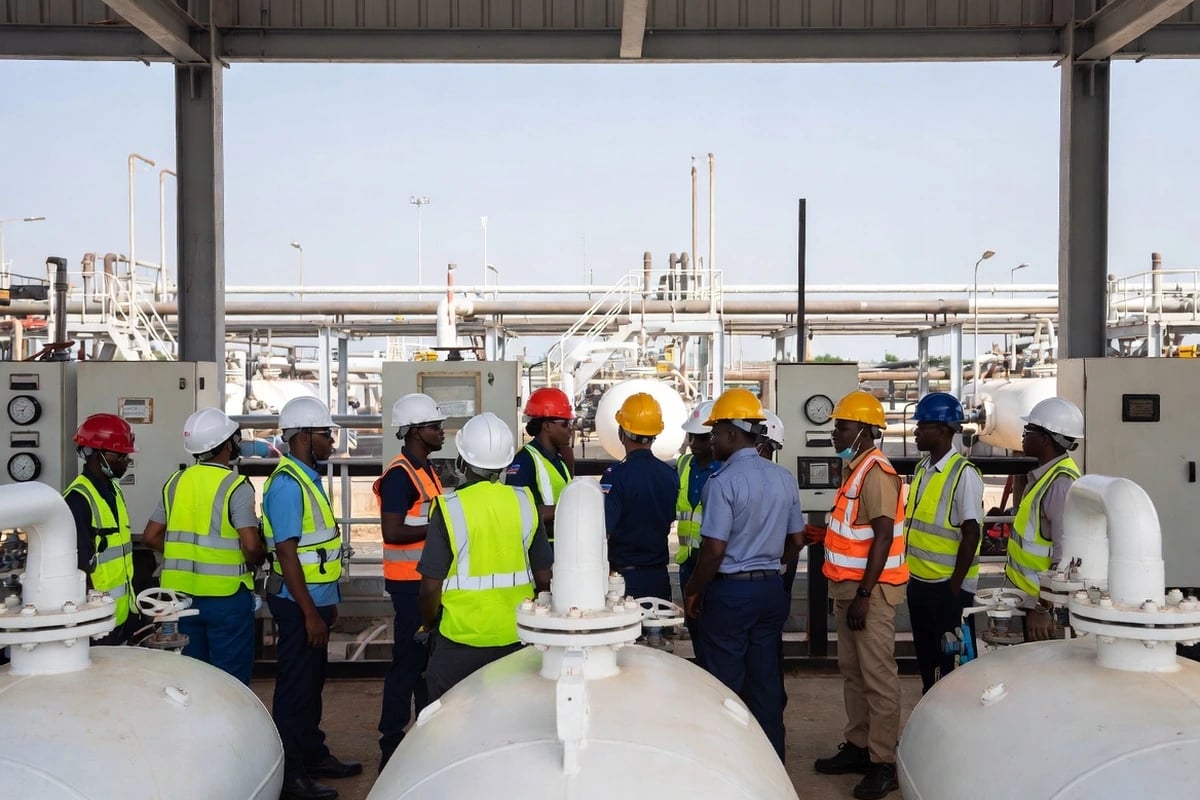
- HSE-disciplined site management aligned to ISO 45001 occupational health and safety practice and ISO 14001 environmental management standards
- Independent product quality verification before receipt and before release, structured to meet the documentation requirements of institutional and regulatory audit
- Post-engagement aftercare schedule issued per service category, preserving operational standards across the full storage and distribution cycle
Typical Project Profile
A Kronix Energy fuel storage and terminal engagement typically spans organisations operating critical fuel-dependent infrastructure — mining operations in the upper regions of Ghana, industrial manufacturing complexes in Tema, aviation ground support facilities at major terminals, government logistics depots, and institutional power backup systems across both Ghana and Togo. Engagements are scoped to the client’s operational cadence, whether continuous bulk storage management or structured periodic replenishment with full terminal oversight. Timelines are defined at the specification stage and governed by documented milestones, not informal estimates.
Outcomes
- Institutional clients receive a complete, auditable chain-of-custody record for every product movement — supporting internal compliance, regulatory inspection, and board-level risk review
- Operational continuity risk is materially reduced through structured replenishment scheduling and documented storage protocols that eliminate informal custody gaps
- HSE exposure is managed systematically, with site practices aligned to internationally recognised occupational health, safety, and environmental management standards
- Post-engagement documentation provides the client’s technical and finance functions with verified volume reconciliation and product quality records, without the burden of reconstruction
- Organisations operating across both Ghana and Togo access a single, process-consistent terminal services framework — removing the operational variability that multi-supplier arrangements typically introduce