The problem
Institutional buyers need a documented, HSE-disciplined source for fuel supply & distribution.
Our approach
Fuel Supply & Distribution
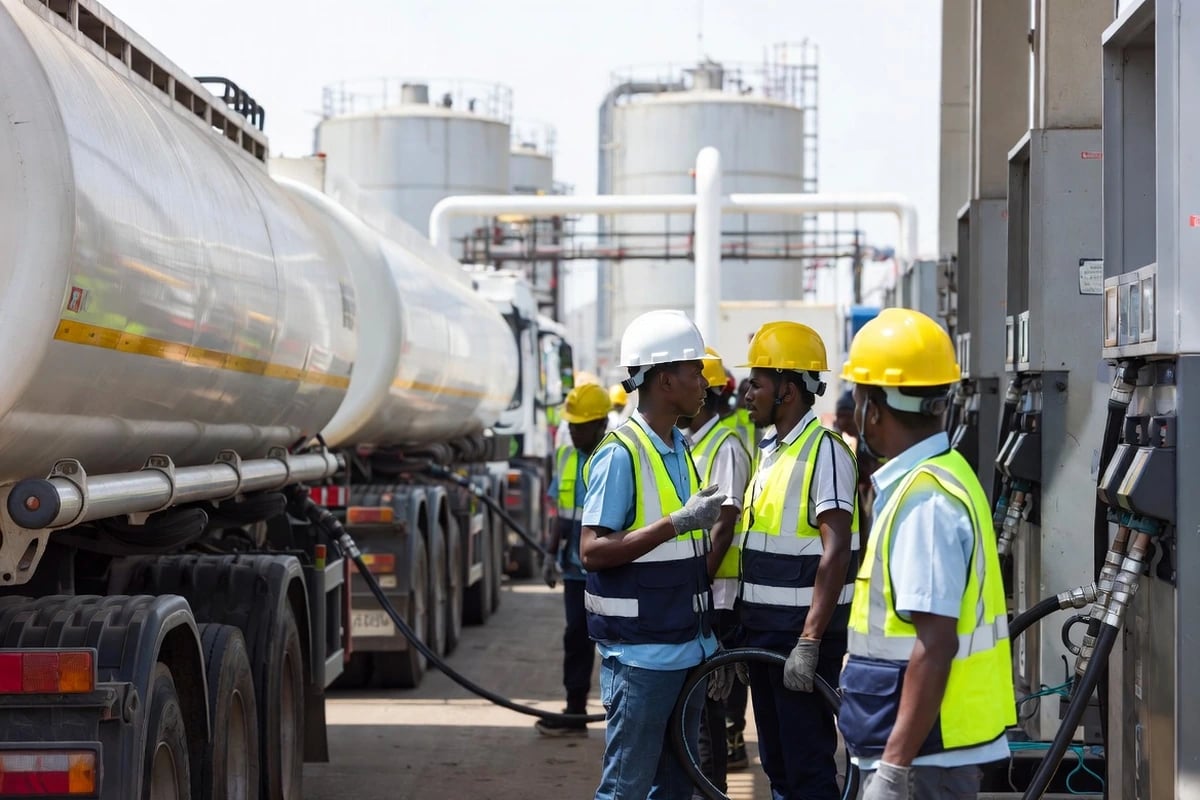
Fuel Supply & Distribution delivered to institutional standard — structured procurement, chain-of-custody discipline, documented handover.
The Challenge
Institutional fuel demand in Ghana and Togo operates on a different logic to retail consumption. A mining operation running continuous shift cycles, an aviation fuelling programme, a government fleet, or a manufacturing facility with uninterrupted process requirements cannot absorb the supply disruptions, documentation gaps, or quality inconsistencies that characterise informal petroleum procurement. The consequences are not inconvenient — they are operational, financial, and in high-consequence environments, safety-critical.
Procurement teams at this level require more than delivery. They require a supply chain that is structured from order confirmation through to signed handover — one where every litre moved is traceable, every transfer is documented, and every deviation from specification triggers a defined response. The market has historically offered volume without rigour. Kronix Energy was built to close that gap.
The regulatory and HSE environment across Ghana and Togo adds a further layer of complexity. Fuel handlers operating at industrial scale must demonstrate environmental compliance, occupational health discipline, and chain-of-custody integrity — not occasionally, but as a condition of continued operation. Institutions that commission fuel supply without documented process accountability carry that risk internally. A supply partner with embedded HSE discipline transfers that assurance outward.
The Kronix Energy Solution
Kronix Energy approaches every institutional fuel supply engagement as a documented operation — not a transaction. Before a single litre moves, a pre-execution specification document is prepared: product grade, volume schedule, delivery logistics, site access protocol, and handover sign-off requirements are agreed in writing with the client. This removes ambiguity at the point of execution and establishes a shared reference against which performance is measured throughout the supply relationship.
During active supply periods, multi-stage quality control checkpoints are embedded into the delivery sequence. Product integrity is verified at dispatch, in transit, and at point of handover. Discrepancies against specification trigger documented escalation — not informal resolution. This discipline is consistent whether the client is receiving a single bulk delivery to a remote site or managing a high-frequency supply programme across multiple locations in Ghana and Togo.
Post-delivery, Kronix Energy maintains documented aftercare records for each supply category. Clients operating under internal audit obligations or regulatory oversight receive complete handover documentation that satisfies chain-of-custody requirements and supports compliance reporting. The record is not an administrative add-on — it is a core deliverable.
Supply Programme Specification
- Product scope: AGO (automotive gas oil), PMS (premium motor spirit), aviation fuels, and industrial petroleum products — supplied to confirmed grade specification
- Coverage: Ghana and Togo, including remote industrial sites, port-adjacent facilities, and in-country distribution corridors
- Documentation standard: Pre-execution specification sign-off, in-transit chain-of-custody records, and post-handover delivery certification at every engagement
- HSE framework: Occupational health and safety discipline embedded across all handling, transport, and transfer operations — aligned to the principles of ISO 45001
- Quality management: Process-based quality controls aligned to ISO 9001 principles, with environmental management practices consistent with ISO 14001 requirements
- Escalation protocol: Defined deviation management procedure activated on any variance from agreed specification — documented, not discretionary
Typical Project Profile
Kronix Energy supply programmes serve institutions with structured, recurring fuel requirements — mining operations running continuous extraction cycles, manufacturers with process-critical energy inputs, aviation fuelling programmes requiring schedule-matched delivery, government and parastatal fleet operations, and financial institutions managing generator-dependent infrastructure. Engagements range from structured periodic supply contracts to high-frequency operational support programmes, and are calibrated to the client’s demand pattern, site logistics, and compliance obligations from the point of initial specification through to ongoing supply management.
Outcomes
- Uninterrupted fuel availability aligned to the client’s operational schedule, with no reliance on spot-market improvisation
- Complete chain-of-custody documentation at every handover — supporting internal audit, regulatory compliance, and financial reporting
- HSE-disciplined supply operations that remove institutional liability associated with undocumented or informally managed petroleum procurement
- Consistent product quality maintained across the supply programme through embedded multi-stage verification
- A supply relationship structured around documented accountability — not volume alone