The problem
Institutional buyers need a documented, HSE-disciplined source for lubricants & specialty products.
Our approach
Lubricants & Specialty Products
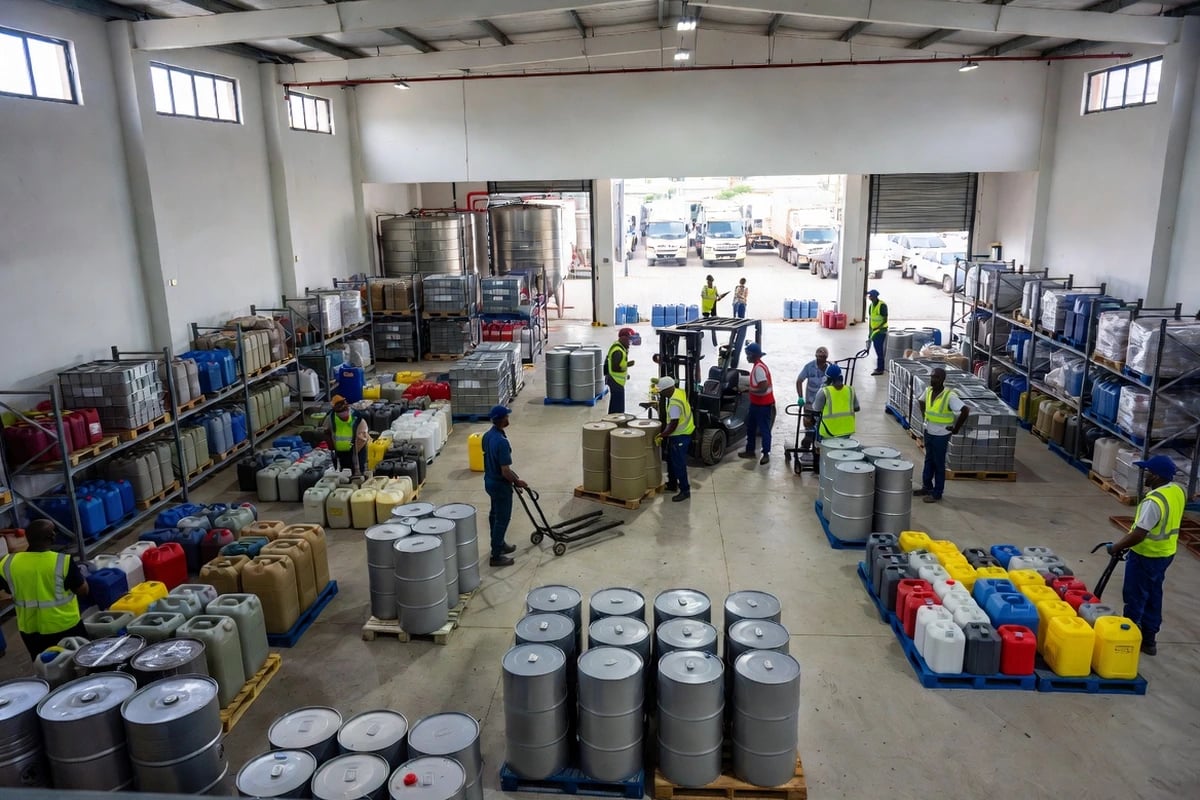
Lubricants & Specialty Products delivered to institutional standard — structured procurement, chain-of-custody discipline, documented handover.
The Challenge
Institutional operations in Ghana and Togo place demands on lubricant supply that bear little resemblance to retail procurement. A mining operation running continuous shift cycles, a manufacturer sustaining precision machinery across multiple production lines, or an aviation ground-support facility managing critical equipment—each requires lubricants and specialty products specified to the exact viscosity grade, additive profile, and OEM standard their systems demand. Substitution, mislabelling, or documentation gaps do not produce minor inconvenience; they produce equipment failure, voided OEM warranties, and operational downtime measured in production loss.
The procurement environment compounds the challenge. Lubricant product lines are technically complex—base oil grades, performance classifications, and application-specific formulations require a counterpart that can translate technical specification into reliable, documented supply. Many procurement teams inherit legacy products without the documentation trail to verify chain of custody, batch integrity, or original specification alignment. In regulated sectors—aviation ground operations, pharmaceutical manufacturing, food-grade processing—the absence of that trail carries compliance exposure.
Specialty products introduce an additional layer of complexity. Hydraulic fluids, transformer oils, metalworking fluids, and process chemicals each carry their own handling, storage, and compatibility requirements. Institutional procurement of these products demands a supply partner with the discipline to manage that complexity systematically, not on a best-effort basis.
The Kronix Energy Solution
Kronix Energy approaches lubricants and specialty products procurement as a specification management exercise, not a commodity transaction. Engagement begins with a pre-supply survey: understanding the client’s equipment register, OEM requirements, application environments, and existing product inventory. A specification document is produced and signed off before any product is sourced, establishing an agreed technical baseline that governs the entire supply relationship.
Supply execution follows a multi-stage quality control protocol. Products are verified against specification at point of sourcing, again at the Kronix handling stage, and documented at every handover. Batch records, technical data sheets, and chain-of-custody documentation accompany each delivery as standard—not as an optional add-on. This discipline is designed specifically for clients whose internal compliance, audit, or maintenance teams require a traceable record.
Post-supply, Kronix maintains a documented aftercare schedule aligned to reorder cycles, product shelf-life parameters, and any changes in the client’s equipment register or operational profile. The relationship is managed as an ongoing institutional account, with specialist advisory available when specification questions arise.
Product and Process Scope
- Engine oils, gear oils, and transmission fluids specified to OEM grade and performance classification
- Hydraulic fluids and compressor oils for industrial and mining applications
- Transformer oils and dielectric fluids for power infrastructure clients
- Aviation-grade lubricants and ground-support specialty products
- Metalworking fluids, release agents, and process chemicals for manufacturing environments
- Chain-of-custody documentation, batch records, and technical data sheets issued at every handover
Typical Engagement Profile
A typical Kronix lubricants engagement serves an industrial manufacturer, a mining operation, an aviation ground-handling facility, or a power utility across Ghana or Togo. Engagements are structured on scheduled supply cycles—monthly, quarterly, or aligned to operational maintenance windows—with volumes, product specifications, and documentation requirements agreed in advance. Emergency replenishment protocols are established at the outset for clients whose operations cannot tolerate supply interruption.
Outcomes
- Equipment operates within OEM-specified lubrication parameters, reducing unplanned maintenance events
- Procurement teams hold a complete, audit-ready documentation trail covering every product delivery
- Compliance exposure from mislabelled or unverified product is systematically eliminated
- Specification drift—where incorrect products enter the supply chain through informal procurement—is prevented at the sourcing stage
- Institutional clients gain a single, accountable supply relationship for their full lubricants and specialty products register across Ghana and Togo